
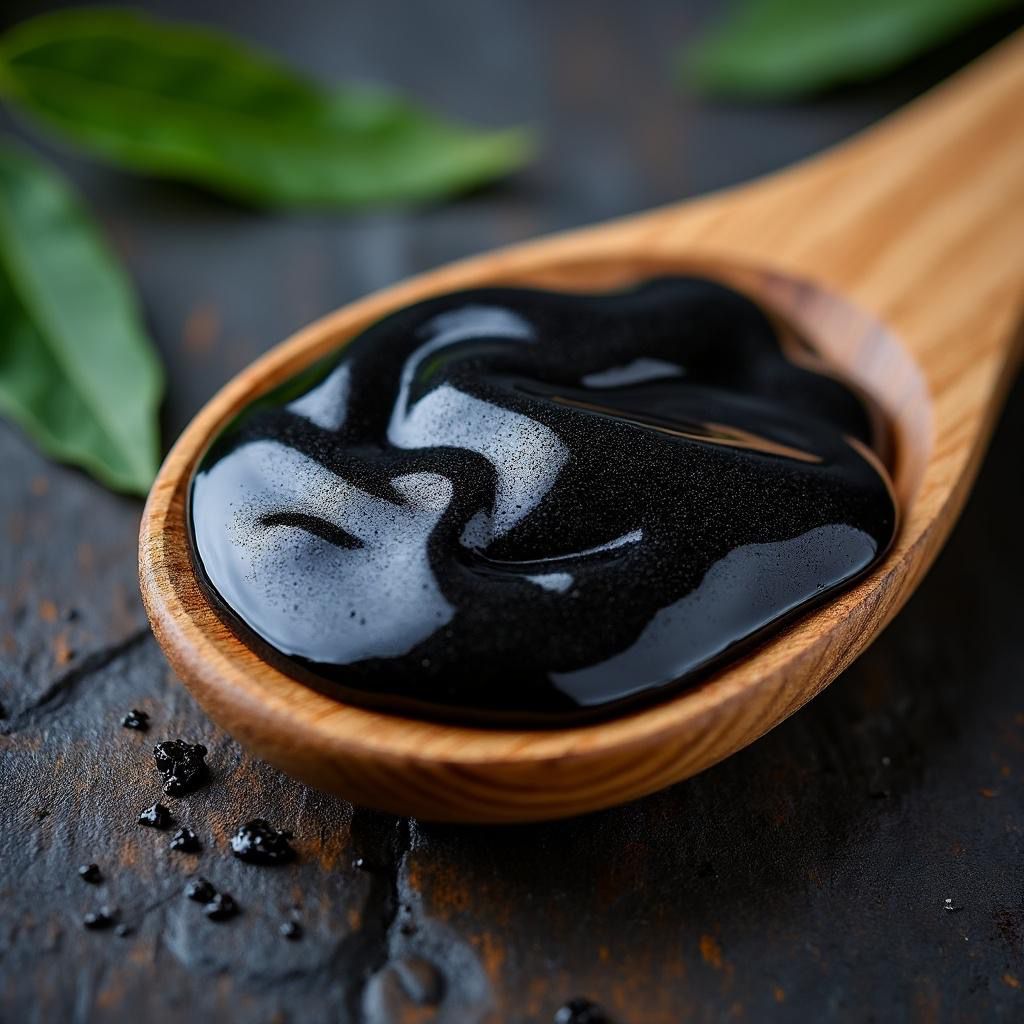
Many buyers expect "pure" shilajit to be completely free of visible particles. A flawless, uniform resin without any irregularities. This sounds logical – but it is a misconception.
Natural inclusions are often the opposite of a lack of quality. This article explains why. The complete quality assessment can be found at how to recognize genuine shilajit.
What are natural inclusions in shilajit?
Natural inclusions in shilajit are tiny mineral particles, microscopic plant residues, or rock-related crystals that remain in the resin when it is gently purified. They arise from the natural formation of the resin in rock crevices and are a sign of minimal processing – not a sign of poor quality.
Specifically, these include:
- Tiny mineral particles from the rock of the deposits
- Microscopic remnants of plant-based source substances
- Slight inhomogeneity in color or texture
These characteristics are part of the resin's history – not impurities in the sense of quality defects.
Why inclusions are not a quality defect
Shilajit forms over centuries in rock crevices of high-altitude regions like Gilgit-Baltistan. The raw material naturally contains traces of its geological origin.
Gentle purification – as employed by Mumio – removes coarse impurities: sand, dust, large rock fragments. What remains in the resin are the characteristic natural components. To remove these completely would mean: more processing steps, more aggressive filtration, more interference with the natural structure.
Slight inhomogeneity and small natural particles are a sign that a product has been minimally processed – not a sign of poor quality.
What actually constitutes a quality problem
Not every inclusion is harmless. Quality problems arise from:
- Foreign materials: sand, soil, organic foreign substances that are not part of the resin
- Adulterants: deliberate additions of sugar, foreign resins, oils, or soil material to increase weight
- Heavy metal contamination: measurable by laboratory analysis, not visually detectable
These problems are not recognizable by visual inspection. They are only verifiable through independent laboratory analysis with heavy metal measurement, mineral profile, and absence testing for additives. Details can be found under Swiss laboratory testing.
The misconception of "perfect" appearance
Industrially heavily filtered shilajit often looks flawless: uniform texture, no visible particles, smooth surface. This is not automatically a quality feature.
To achieve this appearance, several processing steps are necessary:
- Fine filtration down to a microscopic level
- Often high temperatures or chemical aids
- Possible alteration of the natural composition
The result is an optically "perfect" product – but one that may have lost important natural components.
"Pure" means: free from harmful foreign substances. Not: free from all natural traces.
How Mumio handles purity
Mumio uses multi-stage, gentle purification. The goal is balance:
- Removing what does not belong: foreign particles, sand, coarse residues
- Preserving what does belong: the natural mineral matrix, fulvic acids, trace elements
The result is a shilajit that does not look "flawless" – but is authentic. Small natural inclusions may be present. This is deliberately so.
Whether a product is truly pure – free from heavy metals, adulterants, and microbiological contamination – is independently tested for each Mumio batch by Biolytix AG in Switzerland.
Frequently Asked Questions about Inclusions in Shilajit
Must pure shilajit be free of particles?
No. Gently purified, natural shilajit can contain very small natural inclusions. "Pure" means: free from harmful foreign substances. Absolute particle freedom is a sign of extensive processing – not of better quality.
Are all inclusions harmless?
Natural mineral inclusions from the resin's region of origin are harmless. Foreign materials, adulterants, or heavy metal contamination, however, are quality problems – only detectable through laboratory analysis.
How do I distinguish adulterants from natural inclusions?
Visually, this is hardly possible. Sugar can cause a sweet smell, foreign resins change consistency and color. Adulterants can only be reliably detected by chemical laboratory analysis.
Why does Mumio shilajit sometimes look inhomogeneous?
Slight inhomogeneity is normal for natural resin. Mumio filters gently – not to optical perfection. The result is an authentic product with a visible natural origin.
Conclusion
Natural inclusions in shilajit are not a quality defect – they are an expression of natural processing. What actually indicates quality is not the appearance, but the independent laboratory report with heavy metal values and mineral profile.
Mumio supplies shilajit from Gilgit-Baltistan that is gently purified and tested by Biolytix AG in Switzerland. If you are looking for this natural resin: Buy Shilajit Switzerland.

Leave a comment
This site is protected by hCaptcha and the hCaptcha Privacy Policy and Terms of Service apply.