
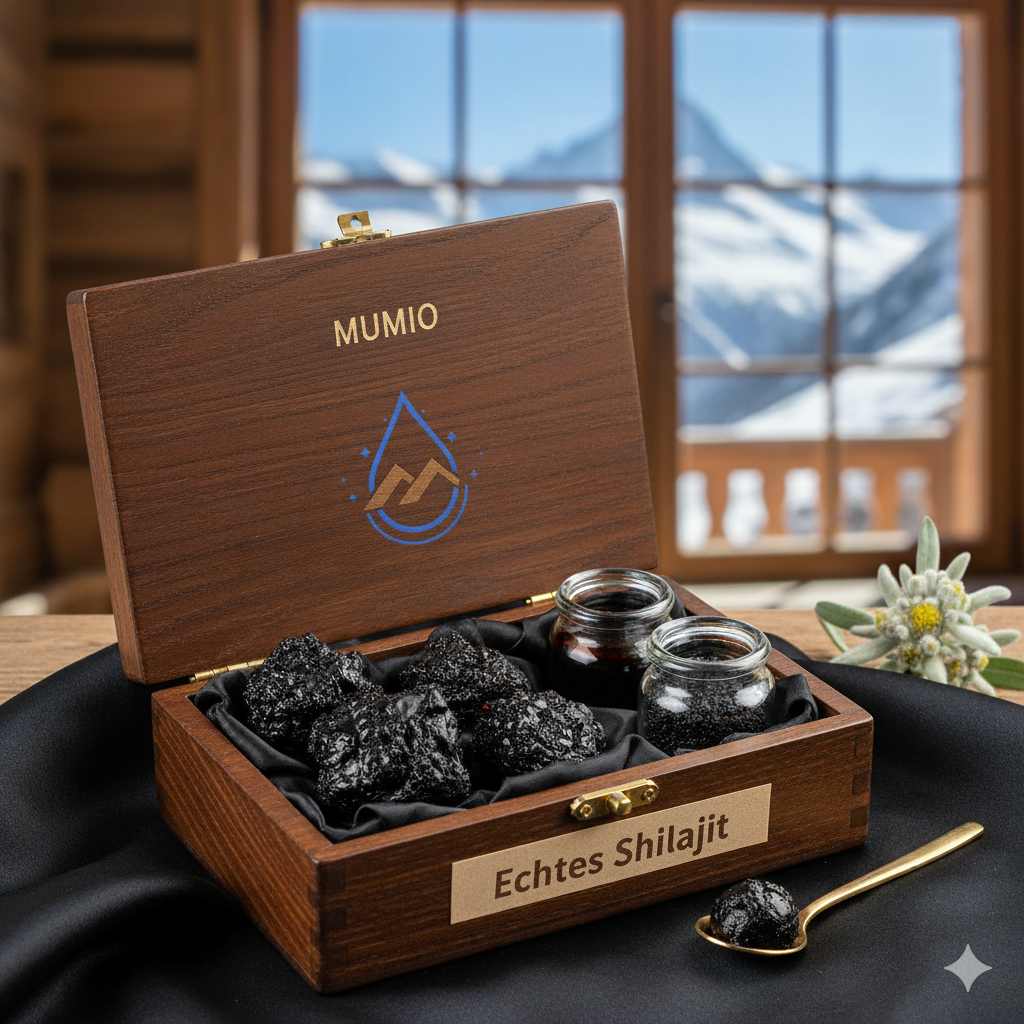
The Shilajit market is growing – and with it the supply of inferior, adulterated, or industrially processed goods. If you want to buy genuine Mumijo, you need to know how to recognize it. This article shows you seven concrete characteristics that distinguish genuine natural resin from questionable products.
The basic principle upfront: Not every visual anomaly indicates a quality defect. Origin, processing, and laboratory testing are always decisive. More on this in the Shilajit Guide.
Why Real Shilajit is So Difficult to Identify
High-quality Shilajit forms over centuries in high-altitude regions like Gilgit-Baltistan in Pakistan. This natural maturation process cannot be accelerated or imitated. Nevertheless, numerous products are marketed as "natural" or "premium" but are heavily processed, adulterated, or reconstructed.
The problem: Many of these products look good externally. Industrially manufactured products are often trimmed for optical perfection – uniform color, smooth texture, not a single particle. Precisely this can be a warning sign.
The 7 Quality Characteristics of Genuine Shilajit
You can recognize genuine Shilajit by these 7 characteristics: dark brown to black color, solid consistency at room temperature, earthy mineral odor, complete solubility in warm water, natural mineral inclusions, no adulterants, and independent laboratory analysis with heavy metal testing and mineral profile.
1. Color – Dark brown to deep black
High-quality Shilajit has a deep dark, brown to black coloration with a natural sheen. The color is due to the high content of humic acids and organic compounds.
Warning signs: pale coloration, milky turbidity, uneven color distribution. These can indicate adulteration, reconstruction, or inferior raw materials.
2. Consistency – Solid at room temperature, soft when warm
At room temperature, genuine Shilajit is firm to viscous. With slight warming – for example, by body temperature or warm water – it becomes soft and pliable. When cold, it hardens again.
Crumbly consistency, powdery structure, or oily softness usually indicate heavy processing or additives.
3. Odor – Earthy, mineral, resinous
Genuine Shilajit has a characteristic smell: earthy, slightly mineral, resinous. This odor is due to its natural composition of organic compounds and minerals.
Warning signs: sweetish odor (possible sugar additives), perfumed notes (flavorings), chemical or pungent odor (solvent residues).
4. Solubility – Complete dissolution in warm water
Natural Shilajit dissolves completely in warm water and dyes the water uniformly dark. This creates a clear, uniform color without streaks or an oily film.
Small mineral residual particles may be present in natural resin – this is normal. However, significant residues, oily films, or greasy streaks are warning signs.
5. Natural inclusions – Not a flaw, but a sign
A common misconception: genuine Shilajit must be absolutely free of particles. The opposite is often the case. Natural resin occasionally contains tiny mineral inclusions, microscopic plant residues, or slight inhomogeneity.
These characteristics arise because the resin grows in rock crevices over centuries. They are a sign of minimal processing – not a sign of poor quality.
Industrially "perfect"-looking resin has often been heavily filtered, diluted, or reconstructed. Optical flawlessness can be a quality feature – but not necessarily.
6. No adulterants – what really counts as fake
Natural inclusions are not adulteration. Intentional foreign additives for artificial weight or volume increase are problematic:
- Foreign resins of unknown origin
- Sugar, molasses, or syrup
- Soil or powder admixtures
- Oils or fats for consistency adjustment
These interventions deliberately alter the product. They pose a clear quality risk and are detectable by laboratory analysis.
7. Laboratory analysis – the only reliable standard
Appearance, odor, and home tests provide clues – but do not replace a thorough quality check. The only objective standard is independent laboratory analysis.
Crucial test parameters:
- Heavy metals (lead, cadmium, arsenic, mercury)
- Microbiological purity
- Mineral profile including manganese content
- Moisture content
- Absence of additives
Mumijo has every batch independently tested by Biolytix AG in Switzerland. The results are batch-specific, documented, and traceable. Details can be found under Swiss Laboratory Testing.
What truly constitutes adulteration
Adulteration means: deliberate foreign additives that increase the product's mass or weight without adding quality. Not every inhomogeneity in the resin is adulteration.
Typical adulterants detectable by laboratory analysis:
- Molasses or sugar (carbohydrate addition)
- Resins from other sources (foreign resin)
- Clay or soil (weight increase)
- Vegetable oils (consistency manipulation)
Anyone who buys a product without laboratory proof has no control over these parameters.
The water test – initial clues, not a substitute
The so-called water test is a common method for basic evaluation:
- Add a small amount of Shilajit to warm water
- Stir and let dissolve
- Observe residues, streaks, or oily films
High-quality resin dissolves completely. Sand, particles, or oily residues are warning signs.
This test does not replace laboratory analysis. It provides initial clues – nothing more.
Frequently asked questions about recognizing genuine Shilajit
Must genuine Shilajit dissolve completely?
Largely yes. Genuine Shilajit largely dissolves in warm water. Very small mineral residual particles may be present in natural resin. However, significant residues, oily films, or greasy streaks are indications of quality problems.
Are mineral inclusions a quality defect?
No. Tiny mineral inclusions are normal in natural Shilajit. They result from its natural formation in rock crevices. A problem only arises if the inclusions consist of foreign material – soil, sand, organic foreign particles. This is what distinguishes laboratory analyses from mere visual inspections.
How do I identify adulterants in Shilajit?
Visually, this is hardly possible. Sugar can cause a sweetish odor, foreign resins change color and consistency. Adulterants can only be reliably detected through independent chemical laboratory analysis.
Which laboratory values are crucial?
The most important parameters: heavy metal levels (lead, cadmium, arsenic, mercury) below legal limits, microbiological purity, mineral profile including manganese content, and moisture content. Reputable providers disclose these values batch-specifically and with a date stamp.
Conclusion
Recognizing genuine Shilajit requires more than just looking at the packaging. Color, consistency, odor, and solubility provide initial clues. The only reliable standard is independent laboratory analysis with documented heavy metal levels and mineral profiles.
Mumio supplies natural Shilajit from Gilgit-Baltistan – laboratory-tested by Biolytix AG in Switzerland, with full batch transparency. If you are looking for genuine Shilajit: Buy Shilajit Switzerland.
Gutes Shilajit erkennen: zusätzliche Qualitätsmerkmale
Gutes Shilajit erkennst du nicht an lauten Versprechen, sondern an nachvollziehbaren Fakten: klare Herkunft, natürliche Harzform, lösliche Konsistenz und eine unabhängige Prüfung auf Schwermetalle und mikrobiologische Qualität.
Echtes vs. fragwürdiges Shilajit
| Merkmal | Gutes Zeichen | Warnsignal |
|---|---|---|
| Herkunft | konkrete Region wie Gilgit-Baltistan / Astore-Tal | nur vage Himalaya-Werbung ohne Nachweis |
| Form | naturbelassenes Harz | unklare Pulver-, Kapsel- oder Gummy-Mischung |
| Prüfung | unabhängige Laboranalyse mit Charge | keine Angaben zu Schwermetallen oder Mikrobiologie |
| Copy | vorsichtige Qualitätsaussagen | Heilversprechen oder unrealistische Superlative |
Harz, Kapseln oder Gummies – worauf achten?
Reines Mumijo Harz ist die ursprünglichste Form. Kapseln, Pulver und Gummies können praktisch sein, enthalten aber je nach Anbieter Trägerstoffe, Süssungsmittel oder zusätzliche Verarbeitungsschritte. Wer echtes Shilajit kaufen möchte, sollte Zusammensetzung und Laborangaben genau prüfen.
Laborprüfung und Schwermetalle
Shilajit ist ein Naturprodukt aus mineralreichen Gesteinsschichten. Deshalb ist eine unabhängige Laborprüfung wichtig. Bei Mumio steht die Schweizer Prüfung im Mittelpunkt, damit Herkunft, Reinheit und Sicherheit nachvollziehbar bleiben.
Häufige Fragen zur Qualität
Wie erkennt man echtes Shilajit? Achte auf Herkunft, Harzform, Löslichkeit, Geruch, unabhängige Laborprüfung und transparente Chargenangaben.
Kann Shilajit Schwermetalle enthalten? Als Naturprodukt kann Shilajit unerwünschte Rückstände enthalten. Deshalb ist eine Prüfung jeder Charge wichtiger als reine Herkunftsversprechen.


Leave a comment
This site is protected by hCaptcha and the hCaptcha Privacy Policy and Terms of Service apply.