

The effects of Shilajit is one of the most searched topics regarding the natural mineral resin from the Himalayas. What is this resin made of – and what does science say about it?
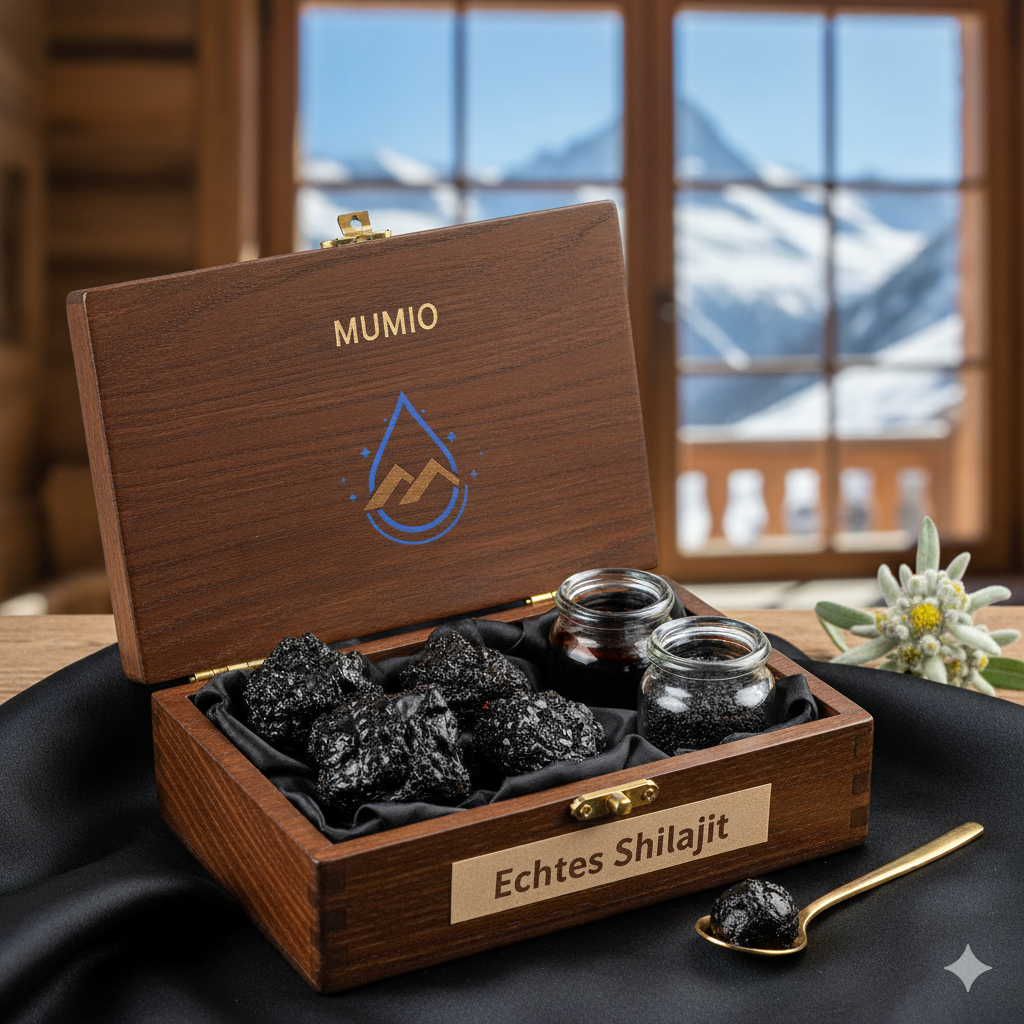
Shilajit, also known as Mumijo, forms over centuries in the high mountains of Central and South Asia. Plant and mineral deposits mineralize over geological processes into a black-brown, resinous natural product. At Mumio, the focus is on pure, independently laboratory-tested Shilajit resin from Gilgit-Baltistan.
You can find the full context in the Shilajit Guide.
What is Shilajit – and how does Mumijo form?
Shilajit originates from plant residues, mosses, and microorganisms that mineralize in rock crevices of high-mountain regions over very long periods under pressure, heat, and cold into a resin-like natural product. This process takes centuries to millennia, making Shilajit one of the most geologically complex natural products.
Its unique formation explains why Shilajit cannot be synthetically replicated and why its origin and processing quality directly influence its composition.
The natural composition of Shilajit
The effect of Shilajit is attributed to its complex natural composition. Genuine Shilajit resin contains a matrix of:
Fulvic acids
Formed by microbial decomposition of organic substances in high mountains. Fulvic acids can bind minerals and support their bioavailability in the body – an active research area.
Manganese and other trace elements
Natural minerals from the rock matrix of the region of origin – including manganese, iron, copper, zinc, and other trace elements. Manganese is the only trace element in Shilajit that is backed by EFSA-approved health claims.
Humic acids and organic compounds
Natural compounds formed by weathering processes in high mountains. Humic acids are part of the complex natural matrix of the resin.
The composition varies depending on the region of origin, altitude, and batch – as it is a natural product, minimal differences between batches are normal.
Why origin determines composition
Shilajit from Gilgit-Baltistan is considered particularly high quality. The remote region over 3,000 meters is free from industrial pollution. This directly influences the natural purity and composition of the extracted resin.
Mumio sources its Shilajit specifically from the Astore Valley in Gilgit-Baltistan. Co-founder Wasseem Wazi comes from this region and has direct access to the collector families who have been working at these sites for generations. More about the origin: Shilajit Gilgit-Baltistan.
Shilajit's effect on energy and metabolism
The effect of Shilajit is based on its natural manganese content. Manganese demonstrably contributes to normal energy metabolism and protects cells from oxidative stress – a statement approved by the European Food Safety Authority (EFSA). Further research into other ingredients is still in early stages.
Unlike artificial energy products, the effect is not based on short-term stimulation from caffeine or sugar. Shilajit provides minerals from a natural source – a relevant difference for people with an active lifestyle or high daily demands.
The EFSA statements refer to the natural manganese content, confirmed by laboratory testing by Biolytix AG in Switzerland. Mumio makes no health claims beyond this proven statement.
Swiss laboratory testing – the basis for reliable quality
For the actual effect of Shilajit to be assessed, purity is crucial. Adulterated or contaminated Shilajit does not have the same natural composition as pure resin from a controlled origin.
At Mumio, Biolytix AG tests each batch for:
- Manganese content – Detection of the naturally contained trace element
- Heavy metals – Lead, cadmium, arsenic, mercury
- Microbiological purity – Safety from bacterial contamination
- Moisture content – Quality feature for consistency and shelf life
Only batches that pass these tests are bottled and shipped. Details: Shilajit Lab-Tested Switzerland.
Tradition and modern science
The traditional use of Shilajit has been documented for centuries – particularly in the Ayurvedic tradition of South Asia as a so-called Rasayana substance. Modern research has begun to systematically investigate its ingredients – especially fulvic acids, the mineral matrix, and the bioavailability of the compounds it contains.
The research situation is still in an early phase. Clear clinical conclusions are not currently possible. Mumio consciously combines traditional origin with modern Swiss quality control – not with healing promises.
Shilajit application and dosage
Shilajit resin can be easily integrated into daily life. The recommended application:
- Amount: approx. 300–500 mg (rice grain size to small pea)
- Frequency: 1× daily
- Preparation: dissolve completely in warm water, tea, or milk
This dosage form allows for flexible dosing and good absorption. The intake is based on traditional routines and can be individually adjusted. All details: Shilajit Sport and Shilajit Dosage.
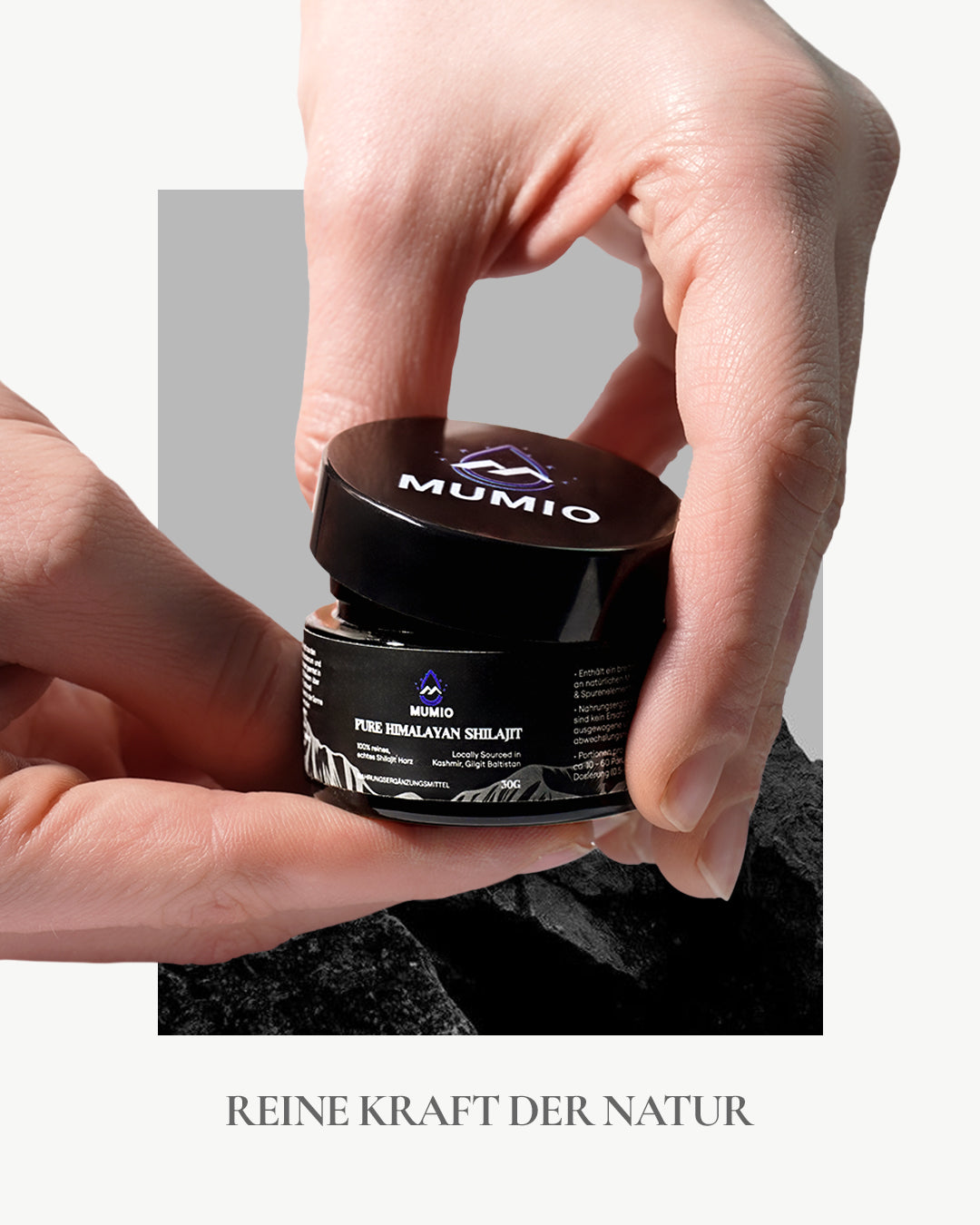
Shilajit resin is the most natural form: The natural composition of fulvic acids, manganese, and other trace elements remains fully intact. Unlike capsules or powder, the resin remains in its original form – without drying processing, without excipients.
Frequent questions about Shilajit's effect
How quickly does Shilajit work?
Shilajit is not a short-term stimulant. The effect is based on the natural mineral matrix – especially manganese, which contributes to normal energy metabolism. Regular intake over several weeks is recommended.
Can I take Shilajit daily?
Yes. Shilajit is designed as a dietary supplement for daily intake. Do not exceed the recommended daily portion. Consult a doctor beforehand if you have illnesses or are taking medication.
Is Shilajit's effect scientifically proven?
The EFSA-approved statements on manganese are scientifically recognized. Further research on Shilajit is ongoing but is still in early stages. Mumio makes no health claims.
Who is Shilajit suitable for?
Shilajit is a dietary supplement for adults. It is suitable for all genders. Not recommended for pregnant or breastfeeding women or individuals under 18 without medical consultation.
What is the difference between Shilajit and Mumijo?
Shilajit and Mumijo are two names for the same natural resin. "Shilajit" is the Sanskrit term, "Mumijo" is the Russian-Eastern European designation. More on this: Mumijo Shilajit on mumio.ch.
Conclusion – Shilajit's effect realistically classified
The effect of Shilajit is based on its natural mineral matrix – especially the manganese it contains, which contributes to normal energy metabolism and protects cells from oxidative stress.
The quality of the product is crucial for its actual effectiveness: origin, purity, processing, and independent laboratory testing make the difference between genuine Mumijo and inferior products.
Mumio stands for transparent supply chains, Swiss quality control by Biolytix AG, and natural, premium Shilajit from Gilgit-Baltistan.
If you are looking for natural, lab-tested Shilajit: Buy Shilajit Switzerland.
Mumijo Wirkung: wissenschaftlich und realistisch einordnen
Viele Suchanfragen drehen sich um Wirkung, Vorteile und traditionelle Verwendung von Mumijo. Wichtig ist eine saubere Trennung: Traditionelle Erfahrungswerte sollten realistisch eingeordnet und nicht mit gesicherten Gesundheitsversprechen verwechselt werden.
Was lässt sich seriös sagen?
Mumijo enthält natürlich vorkommende organische und mineralische Bestandteile wie Fulvinsäuren und Spurenelemente. Welche Zusammensetzung vorliegt, hängt von Herkunft, Reinigung und Charge ab. Deshalb stellt Mumio transparente Laborprüfung, Herkunft und Chargenqualität in den Vordergrund.
Was sollte man kritisch sehen?
Vorsicht ist bei Anbietern geboten, die mit übertriebenen Wirkversprechen oder Krankheitsbezügen arbeiten. Für eine seriöse Kaufentscheidung sind Herkunft, Reinheit, Schwermetallprüfung und eine vorsichtige Dosierung relevanter.

Leave a comment
This site is protected by hCaptcha and the hCaptcha Privacy Policy and Terms of Service apply.