
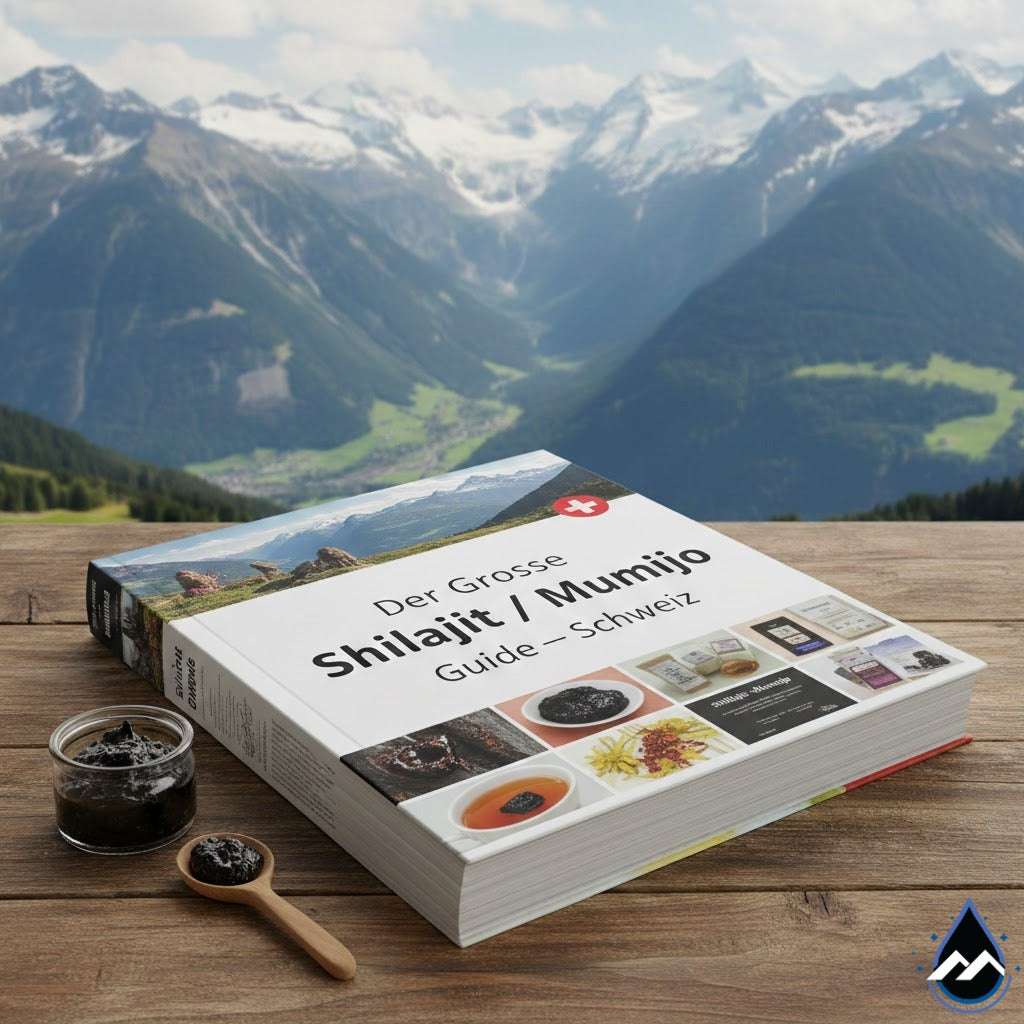
This guide provides a comprehensive and understandable explanation of what real Shilajit (Mumijo) is, how it works, what to look for in terms of quality, and how to use it correctly. Focus: Transparency, Science, and Swiss Quality Standard.
1. What exactly is Shilajit?
Shilajit – also known as Mumijo – is a natural mineral resin that forms over centuries in rock crevices of high mountain regions like Gilgit-Baltistan in Pakistan. It originates from plant and microbial residues that slowly mineralize under extreme pressure, strong temperature fluctuations, and geological processes. Unlike industrially produced dietary supplements, Shilajit is not an extract but a naturally grown product.
Formation in the Himalayas
The formation of Shilajit is closely linked to the geology of the Himalayas. In high mountain regions, plant remains, mosses, and microorganisms have been deposited in rock crevices for millennia. Under the influence of solar heat, frost, pressure, and microbial decomposition, a dark brown to black resinous substance develops over time.
This substance oozes out of the rock at warmer temperatures and can be collected by experienced gatherers. The natural formation process is only possible in a few regions worldwide – which is why genuine, high-quality raw material is limited.
Composition and Ingredients
Genuine Shilajit contains a variety of natural components, including:
- Fulvic acid and humic acids
- Over 80 natural minerals and trace elements
- Amino acids
- Organic plant compounds
- Bioactive compounds
The fulvic acid contained is particularly important as it can bind minerals and support their bioavailability in the body. The exact composition varies depending on the region of origin, altitude, and processing. A detailed overview can be found under Shilajit Effects.
Mumijo and Shilajit – is there a difference?
The terms "Mumijo" and "Shilajit" are used synonymously. "Shilajit" is the common term in the Indian and Nepalese regions, while "Mumijo" is the Central Asian-Russian term. Both refer to the same natural product. Quality differences arise not from the name, but from origin, processing, and laboratory testing.
Distinction from Industrial Products
Numerous products marketed as Shilajit or Mumijo are found on the international market, but they are only comparable to real natural resin to a limited extent. They are often:
- highly processed powders
- synthetically enriched mixtures
- products diluted with excipients
- chemically extracted concentrates
Such products usually have a lower density of active ingredients and lose part of their natural structure due to industrial processing. Real Shilajit remains in its original resin form and is only purified without altering its natural composition.
Commercially Available Forms of Shilajit
Resin (the most natural form): Natural, highly concentrated, no excipients.
Powder: Often highly processed, oxidized, or mixed with excipients. Lower active ingredient density.
Capsules: Convenient to use, but mostly with additives and reduced original structure.
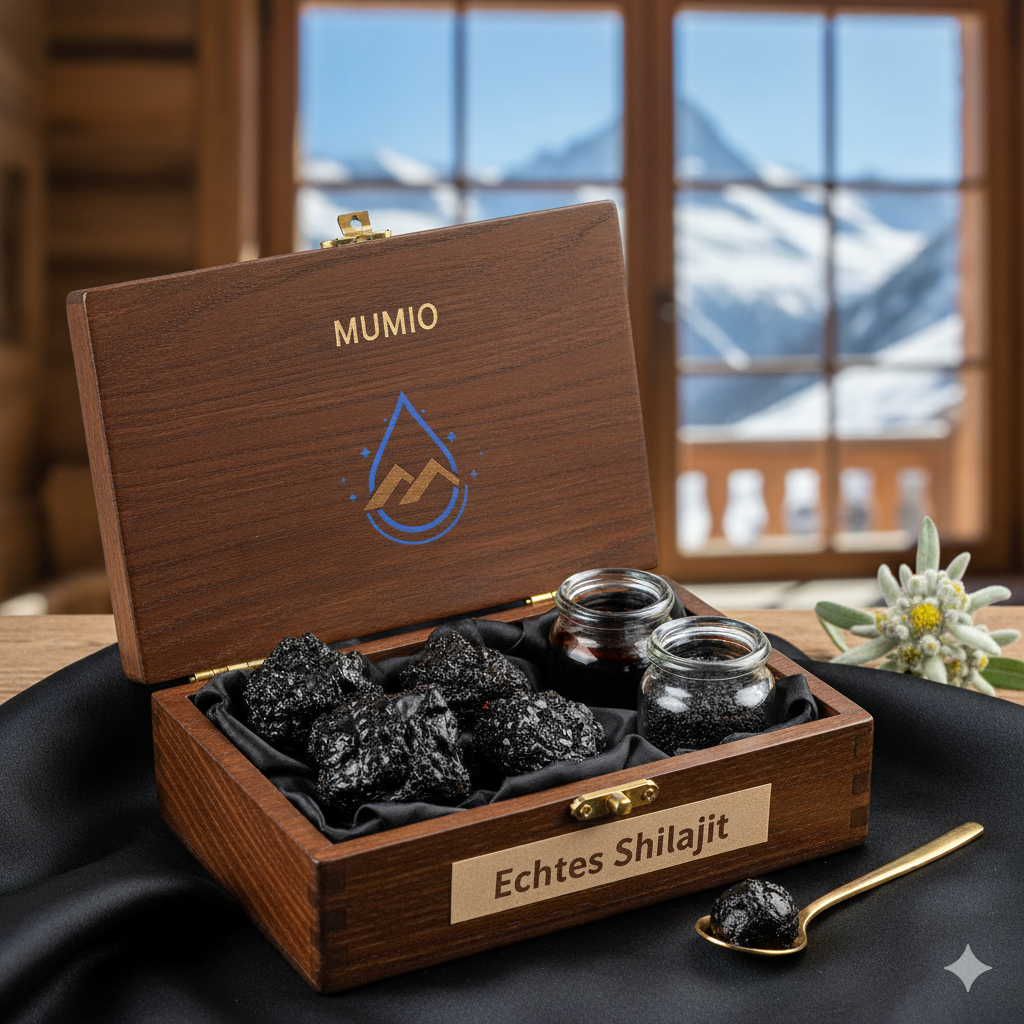
Mumio offers Shilajit exclusively in resin form – natural, without capsules, without powder.
2. Origin & Quality – The Most Important Factor
The quality of Shilajit does not begin in the laboratory or in the packaging, but in the high mountain regions. Genuine, high-quality Shilajit is formed exclusively in a few geographical zones where the necessary climatic, geological, and biological conditions exist.
The most important regions of origin include Gilgit-Baltistan in northern Pakistan, parts of Nepal, and selected regions of northern India. More about the geographical classification: Shilajit Gilgit-Baltistan.
Importance of Origin
Not every product from "the Himalayas" is automatically high quality. The exact region, altitude, and method of extraction are crucial. Shilajit from regions with low environmental pollution and intact nature generally shows higher purity and better mineral content.
Gilgit-Baltistan is considered a particularly high-quality region of origin due to its geological structure – at the intersection of the Himalayas, Karakoram, and Hindu Kush – and its traditional collection methods.
Traditional Collection by Local Gatherers
Collecting Shilajit requires experience, local knowledge, and patience. The resin emerges from rock crevices at warmer temperatures and is carefully detached by hand. Mechanical extraction is unsuitable as it destroys the natural structure and introduces foreign substances.
Mumio works directly with collector families in the Astore Valley in Gilgit-Baltistan. Co-founder Wasseem Wazi comes from this region – allowing direct sourcing without wholesalers.
Purification and Processing
After collection, the raw material is not directly consumable. It contains natural particles such as sand, plant residues, or rock debris. Mumio relies on multi-stage, gentle purification: filtration, sun drying – without the use of aggressive chemicals.
Refraining from Industrial Extraction
A key quality feature is the avoidance of chemical extraction. While such methods can increase the active ingredient content, they alter the natural structure of the product. Genuine premium Shilajit remains in its original resin form – not synthetically enriched, not diluted, not standardized.
Importance of Independent Laboratory Analyses
Independent laboratory tests are crucial for quality control. They confirm purity, mineral content, and safety. Mumio has each batch tested for the following parameters:
- Heavy metals (lead, cadmium, arsenic, mercury)
- Microbiological contamination
- Purity
- Mineral profile
Only documented and current analysis reports allow for an objective assessment. Details: Shilajit lab-tested Switzerland.
Transparency and Traceability
Quality is demonstrated by the transparency of the supply chain. High-quality providers can document the path of Shilajit from the collection area to bottling – with origin information, batch numbers, laboratory reports, and a description of the purification.
Mumio's Approach
Mumio works directly with selected collector families in Gilgit-Baltistan – without intermediaries. Every delivery is independently analyzed by Biolytix AG in Switzerland. This ensures that origin, quality, and safety can be checked at any time.
3. Effects – What Does Science Say?
Shilajit is a complex natural concentrate with minerals, fulvic acid, as well as organic and bioactive compounds.
What is proven: Manganese demonstrably contributes to normal energy metabolism and protects cells from oxidative stress – EFSA-approved statements that refer to the natural manganese content in Shilajit, confirmed by laboratory testing.
What is being researched: Several studies are investigating connections between Shilajit and energy metabolism, cell function, regeneration, and mineral absorption. The research situation is predominantly based on laboratory studies, animal models, and smaller human studies. Large-scale long-term studies are limited.
What Mumio does with this: No promises of healing. The focus is on the proven manganese claim, traceable origin, and tested purity.
Shilajit is not a medicinal product and does not replace medical treatment. The complete scientific article can be found under Shilajit Effects.
4. Application & Dosage
Correct application and dosage are crucial for integrating Shilajit into daily life in a meaningful and safe way.
Recommended daily dosage:
- Amount: approx. 300–500 mg (rice grain size to small pea)
- Frequency: once daily
- Maximum dose: not more than 500 mg per day
Proper Preparation:
- Dissolve in warm water, tea, or milk
- Do not add to boiling water
- Stir well until no residue is visible
Optimal intake time: in the morning on an empty stomach or before physical activity.
Beginner's Introduction: Start week 1 with approx. half dose (150 mg), observe reaction, and gradually increase if well tolerated.
Duration of intake: Many users apply Shilajit in courses for 8–12 weeks, then take a 2–4 week break. All details: Shilajit Dosage.
5. Safety & Side Effects
The safety of Shilajit depends directly on its origin, processing, and quality. With high-quality, purified, and independently laboratory-tested Shilajit, undesirable side effects are rare. Untested or inferior Shilajit can contain heavy metals, microorganisms, or residues.
Possible adjustment reactions in the initial phase: mild fatigue, gastrointestinal discomfort, headaches, altered sleep rhythm. These usually subside quickly with correct dosage.
Special caution: Pregnant women, nursing mothers, individuals with autoimmune diseases, chronic illnesses, or those taking regular medication should seek medical advice beforehand.
A safe product is characterized by current laboratory reports, heavy metal testing, microbiological analyses, and transparent batch documentation. If these proofs are missing, it is advisable not to take it.
6. Recognizing Genuine Shilajit – Quality vs. Imitation
Since Shilajit is complex to obtain, inferior, diluted, or adulterated products are found on the market. The most important quality characteristics – fully explained under recognizing genuine Shilajit:
Physical characteristics:
- Color: dark brown to deep black, slightly shiny
- Consistency: solid to viscous at room temperature, soft and malleable at body temperature
- Solubility: dissolves completely in warm water, evenly coloring the water dark
- Taste: intensely bitter, slightly earthy. A sweet or neutral taste indicates additives
Typical warning signs: unusually low price, missing origin information, no laboratory reports, solely marketing promises.
Premium Shilajit is characterized by origin from defined high mountain regions, manual collection, gentle purification, independent laboratory testing, and complete transparency.
7. Buying Guide: Shilajit in Switzerland
The Swiss market for Shilajit is growing – and with it, the variety of suppliers, qualities, and prices. A conscious and fact-based purchasing decision not only protects your health but also ensures that you receive a product that lives up to its name.
Origin information – the first quality filter: Clear indication of the geographical collection region. "From the Himalayas" without details is too imprecise. Gilgit-Baltistan, Nepal, or Northern India – specific and verifiable.
Swiss laboratory analyses: Independent testing bodies, current analysis data, visible limit values and results – not just "Passed/Fail". A product without such test reports should not be purchased without further consideration.
Batch number & traceability: Every production unit should have a batch number – for traceability to the laboratory analysis and security in case of quality problems.
Company Transparency: Complete imprint, company headquarters, functioning customer support. Anonymous online shops without contact options are not a safe environment.
Price and Quality: Shilajit forms over centuries and must be painstakingly extracted, purified, and tested. This is reflected in the price. Very cheap products are often diluted or untested.
Checklist for Shilajit purchase:
Origin clearly documented
- Swiss or equivalent laboratory analysis
- Batch number and traceability
- Transparent company and contact person
- Clear ingredients without fillers
- Realistic price for genuine quality
8. Why Mumio?
The quality of Shilajit is no coincidence but the result of a well-thought-out supply chain, careful processing, and transparent testing processes.
Direct origin from Gilgit-Baltistan: Mumio sources its Shilajit from the Astore Valley in Gilgit-Baltistan. Co-founder Wasseem Wazi comes from this region – this allows direct access to collector families without intermediaries.
No intermediaries: Shorter supply chains mean more control, fewer potential quality losses, and direct partnerships on site.
Independent Swiss laboratory testing: Every batch is independently tested by Biolytix AG in Switzerland for purity, heavy metal levels, microbiological quality, and mineral profiles.
Natural resin without additives: No extract, no powder, no capsules. Only natural Shilajit resin with gentle purification.
Traceability of each batch: Each batch is fully traceable – from extraction to laboratory analysis and bottling.
9. Frequently Asked Questions (FAQ)
Is Shilajit legal in Switzerland?
Yes. Shilajit is legally available in Switzerland, provided it is correctly declared as a food supplement and independent laboratory analyses are available. Mumio complies with all legal labeling requirements.
How long does it take to notice the first effects?
Many users report the first noticeable changes after about 2–4 weeks of regular intake. The individual reaction depends on metabolism, lifestyle, dosage, and product quality.
Can I take Shilajit daily?
Yes. When adhering to the recommended dosage (300–500 mg), daily intake is generally safe. Many users apply Shilajit in courses over several weeks.
What does genuine Shilajit taste like?
Genuine Shilajit has an intensely bitter, slightly earthy taste. A neutral or sweet taste can indicate additives or dilution.
Is Shilajit suitable for athletes?
Shilajit is used by physically active people to support energy metabolism. It does not replace a balanced diet or structured training. More on this: Shilajit Sport.
Are there known interactions with medications?
If taking medication or suffering from existing conditions, medical advice should be sought before use.
Can side effects occur?
With high-quality, tested Shilajit, side effects are rare. In the initial phase, mild adjustment reactions such as fatigue or stomach discomfort may occur. These usually subside quickly.
How do I recognize high-quality Shilajit?
Dark color, complete water solubility, bitter taste, clear origin information, and independent laboratory analyses. Lack of transparency is a warning sign. More: recognizing genuine Shilajit.
Should I take Shilajit in courses?
Many users prefer cyclical application for 8–12 weeks followed by a break. This allows the body to regulate itself naturally.
Is Shilajit suitable for vegetarians and vegans?
Yes. Genuine Shilajit is a plant-mineral natural product with no animal components.
Can I combine Shilajit with other supplements?
In principle, a combination is possible. If you are unsure about overdosing on individual minerals, professional advice is recommended.
10. Conclusion
Shilajit is a complex natural product whose quality depends entirely on its origin, processing, and transparency. Only genuine, carefully purified, and independently tested Shilajit offers the safety and potential described in scientific studies and anecdotal reports.
Proofs of origin, laboratory analyses, batch documentation, and traceable supply chains are not additional features but fundamental quality criteria.
Mumio consistently pursues this quality standard – with direct origin from Gilgit-Baltistan, independent Swiss laboratory testing by Biolytix AG, and complete transparency.
This guide is for informational purposes and does not replace medical advice. For health-related questions, professional advice should be sought.
If you are looking for Shilajit from Gilgit-Baltistan, laboratory-tested in Switzerland: Buy Shilajit Switzerland.


Leave a comment
This site is protected by hCaptcha and the hCaptcha Privacy Policy and Terms of Service apply.