
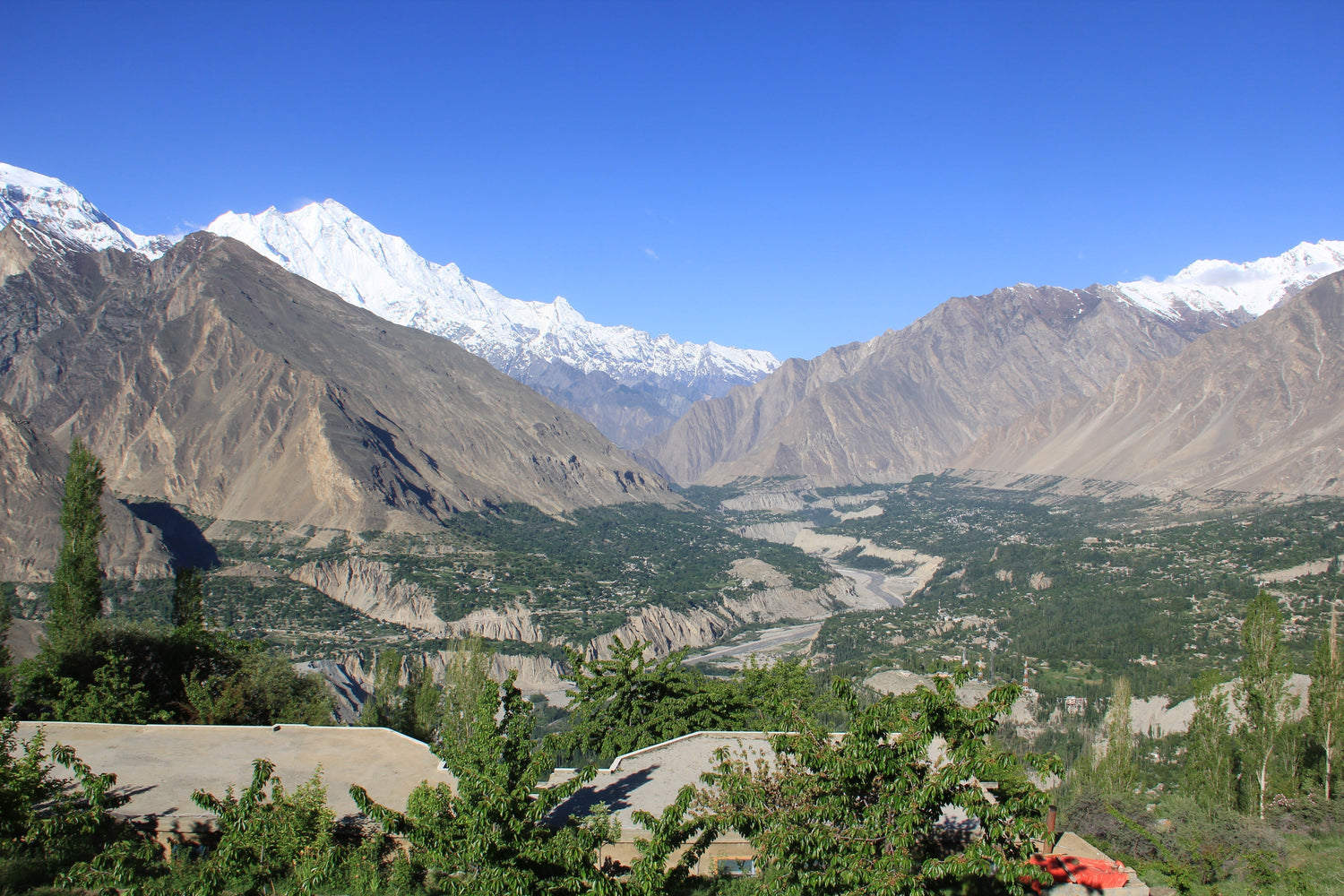
When suppliers write "Himalayan Shilajit," it's often an imprecise geographical designation. The Himalayas are a mountain range extending across several countries – from Nepal to India to Pakistan. Not every corner of this vast region offers the conditions for high-quality shilajit.
This article shows why the specific region is crucial and what makes Mumio from Gilgit-Baltistan special. For a complete overview, see the Shilajit Guide.
The three mountain systems – Himalayas, Karakoram, Hindu Kush
Gilgit-Baltistan in Pakistan lies at the intersection of the three great mountain systems: the Himalayas, Karakoram, and Hindu Kush. This geographically unique region is characterized by extreme altitudes, significant temperature fluctuations, and mineral-rich rock layers – conditions under which shilajit naturally forms in rock crevices over centuries.
This is not a marketing concept. It is geology. Three of the Earth's largest mountain ranges converge in a region that is geologically one of the most complex in the world.
Why geography determines shilajit quality
Altitude and temperature fluctuations
In Gilgit-Baltistan, shilajit is collected at altitudes ranging from over 3,000 to about 5,000–6,000 meters. At these altitudes, seasonal temperature fluctuations are extreme: hot summers, cold winters. This constant change drives the mineralization process that creates shilajit.
Organic residues – plant remains, mosses, microbial matter – are transformed into natural resin over very long periods through pressure, heat, cold, and geological processes.
Mineral-rich rock layers
The rock layers in Gilgit-Baltistan are particularly rich in minerals. These minerals directly influence the composition of the resulting shilajit – including manganese, iron, copper, zinc, and other trace elements, as well as fulvic acids.
The mineral content is no accident but the geological signature of the region of origin.
Remoteness and low environmental impact
Many of the collection areas in Gilgit-Baltistan are only accessible on foot. No roads, no industry, minimal environmental impact. This remoteness is a direct quality feature: the resin forms far from heavy metal contamination from industrial emissions or agricultural chemicals.
Gilgit-Baltistan – the specific region of origin of Mumio
"From the Himalayas" is a category. Gilgit-Baltistan is a region.
Mumio sources its shilajit specifically from the Astore Valley in Gilgit-Baltistan. Co-founder Wasseem Wazi comes from this region. He has personal access to the collector families who have been working at these sites for generations.
This allows Mumio direct, controlled procurement without wholesalers. More information: Shilajit Gilgit-Baltistan – Mumio Origin from Astore.
Natural formation over centuries
Shilajit is not a product that can be cultivated or manufactured. Its formation takes centuries. Plant residues, microorganisms, and mineral compounds mineralize under extreme pressure conditions in rock crevices to form a resin-like natural product.
This long formation process is the reason why:
- Shilajit is not available indefinitely
- Origin and geology have a direct impact on quality
- Industrial replication is not possible
Frequently asked questions about Shilajit origin Himalayas
Does all shilajit come from the Himalayas?
No. Shilajit forms in various high mountain regions: Himalayas, Karakoram, Hindu Kush, but also in parts of Central Asia, Russia, and Northern India. "Himalayan" is a simplifying collective term. The exact region, altitude, and geological composition determine the quality.
What is the difference between "Himalayan Shilajit" and Mumio from Gilgit-Baltistan?
"Himalayan Shilajit" is an imprecise designation that covers many regions. Mumio Shilajit specifically comes from the Astore Valley in Gilgit-Baltistan, Pakistan – at altitudes above 3,000 meters, at the intersection of the Himalayas, Karakoram, and Hindu Kush. This specificity allows for true traceability.
Why is altitude a quality feature?
Higher altitudes mean more extreme temperature fluctuations, cleaner air, and less industrial influence. These conditions promote the natural formation of shilajit with high mineral density and minimal contamination.
How long does it take for shilajit to form?
The natural maturation process takes centuries to millennia. Plant and microbial residues mineralize under pressure, heat, and cold over very long periods. This process cannot be accelerated.
Conclusion
Shilajit from the Himalayas is more than a geographical label. The specific conditions at the intersection of the Himalayas, Karakoram, and Hindu Kush – especially in Gilgit-Baltistan – create the geological prerequisites for high-quality natural resin. Mumio sources its shilajit directly from the Astore Valley in this region – laboratory-tested by Biolytix AG in Switzerland.
If you are looking for this resin: Buy Shilajit Switzerland.

Leave a comment
This site is protected by hCaptcha and the hCaptcha Privacy Policy and Terms of Service apply.