
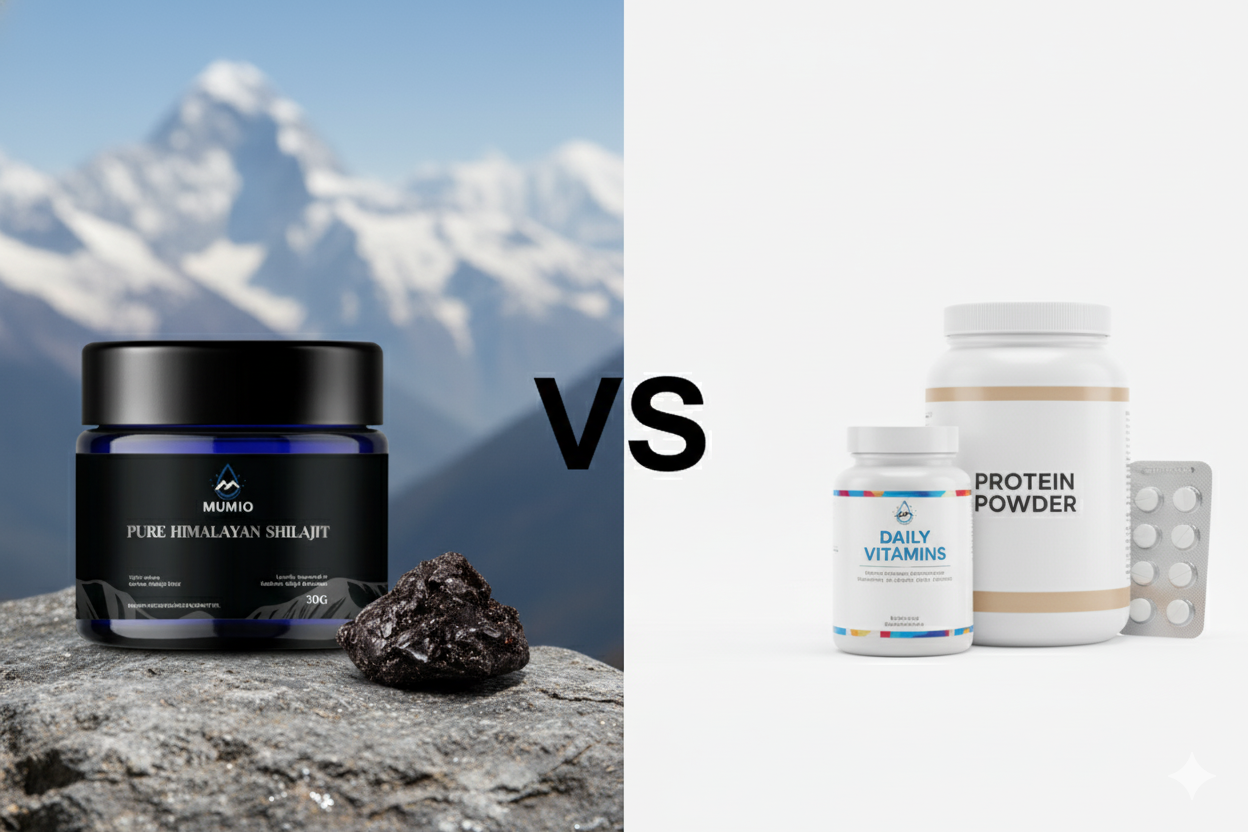
The market for dietary supplements is vast: magnesium, zinc, vitamin D preparations, protein powders, plant extracts. Most of them are based on isolated, industrially produced compounds.
Shilajit – especially natural Mumijo resin – follows a different principle. This article explains the difference and when Shilajit can be a meaningful supplement. You can find the scientific background under Shilajit Effect.
Dietary Supplements – What's Standard in the Market
Conventional dietary supplements usually contain:
- Isolated compounds (e.g., magnesium citrate, zinc sulfate)
- Synthetically produced vitamins
- Carriers, capsule shells, fillers
- Standardized active ingredient content
These products are precisely dosed and generally well-researched. Their advantage: reproducible quality and defined composition. Their disadvantage: isolated individual substances do not correspond to the natural complex of minerals in a natural product.
Shilajit – A Mineral Resin, Not an Isolate
Shilajit is not an extract and not an isolate. It forms over centuries in rock crevices of the high mountains of Gilgit-Baltistan – through the mineralization of plant and microbial residues.
The result is a natural matrix of:
- Manganese, iron, copper, zinc, and other trace elements
- Fulvic acids (formed by microbial decomposition)
- Humic acids (natural weathering products)
- Organic plant compounds
These components are present in the natural resin in their original form – not isolated, not synthetically enriched. The composition varies slightly between batches, as it is a natural product.
Mumijo Shilajit is left in this form: gently cleaned, but not altered. No extraction, no standardization, no enrichment.
The Concrete Comparison
Conventional dietary supplements like magnesium or zinc contain isolated, usually synthetically produced compounds. Shilajit, on the other hand, is a naturally grown mineral resin that forms over centuries in high-mountain regions like Gilgit-Baltistan. It contains a natural matrix of manganese, fulvic acids, humic acids, and other trace elements – unchanged by chemical extraction.
Origin
| Conventional Supplements | Mumijo Shilajit |
| Industrially produced | Naturally grown, Gilgit-Baltistan |
| Synthetic compounds | Natural resin, natural formation |
| Anonymous supply chain | Direct sourcing, batch transparency |
Composition
| Conventional Supplements | Mumijo Shilajit |
| Isolated single substances | Natural mineral matrix |
| Standardized content | Natural variance per batch |
| Carriers often included | No carriers, no additives |
Degree of Processing
| Conventional Supplements | Mumijo Shilajit |
| Chemical synthesis or extraction | Gentle cleaning, no extraction |
| Powders, capsules, tablets | Exclusively resin form |
| Often preservatives | No preservatives |
Quality Assurance
| Conventional Supplements | Mumijo Shilajit |
| Standardized active ingredient content | Batch-specific lab testing |
| Synthetic control | Biolytix AG, independent |
| Reproducible | Natural variance, but tested |
When Shilajit Is Useful – and When It Isn't
Shilajit is not a substitute for specifically dosed individual substances. Those who want to compensate for a proven deficiency of a specific mineral are better off with an appropriate isolate.
Shilajit suits people who:
- Seek a natural, tested natural product
- Value the complete, non-isolated mineral matrix
- Prioritize transparent origin and independent laboratory testing
- Don't want capsules or powders
Frequently Asked Questions – Shilajit vs. Dietary Supplements
Can Shilajit replace magnesium or zinc?
No. Shilajit is not a specific mineral replacement. It contains manganese, which is proven to contribute to normal energy metabolism – but not the high individual doses used in specific therapeutic preparations. Shilajit supplements – it does not replace specifically dosed preparations.
Why is Shilajit more expensive than conventional preparations?
Manual collection in Gilgit-Baltistan, gentle cleaning, independent laboratory testing by Biolytix AG, and direct sourcing without wholesalers: these are real cost factors. Synthetically produced individual compounds are significantly cheaper to manufacture.
Is Shilajit scientifically proven?
The manganese content in the resin and its function in energy metabolism are EFSA-approved. Further research on Shilajit is ongoing but still in early stages. Mumijo makes no health claims.
What makes Mumijo Shilajit different from other Shilajit products?
Three points: direct origin from Gilgit-Baltistan (no wholesaler), exclusively natural resin form (no extract, no powder), batch-specific laboratory testing by Biolytix AG in Switzerland.
Conclusion
Shilajit is not a better magnesium tablet. It is a different product – a naturally grown mineral resin with a complete, unprocessed mineral matrix. Whether this fits one's own routine is an individual decision.
If you want natural, lab-tested Mumijo resin from Gilgit-Baltistan: Buy Shilajit Switzerland.

Leave a comment
This site is protected by hCaptcha and the hCaptcha Privacy Policy and Terms of Service apply.